The Best Storemapper Alternatives
Published
Storemapper was one of the first subscription store locators, and it still has a loyal following. But its prices have gone up at every plan level since 2020, and features such as Google Sheets sync, multi-language support and analytics now need the $69.99 Premium plan. If you're paying more than you'd like or you've outgrown a plan, there are several good alternatives.
We compared seven Storemapper alternatives on price, location limits, map costs, data sync, languages, analytics and platform support. Here's how they stack up.
Quick picks
- Best overallStoreLocatorWidgetsMap usage included on every plan, so no Google billing account. Sheets sync, multi-language and analytics from $39 for 1,000 locations.
- Best for Shopify brandsStockistSimple plans from $10, with sync, analytics and 4 languages for $40, and a 5.0 rating from 353 Shopify reviews.
- Best for Webflow and integrationsStorepointWebflow CMS sync, Airtable, HubSpot and Zapier integrations, and Google Sheets sync every 5 minutes on its top plan.
- Best for enterprise dataMetaLocatorConnects to Salesforce, Yext, HubSpot and Dynamics on its higher plans, with a 30-day free trial.
- Best budget pickCloseby10,000 locations for $19.99 a month with maps included, and a free plan for up to 5 locations.
Storemapper does a lot right. It has been running since 2013, it has a 4.9-star rating from 96 reviews on the Shopify App Store, and it has setup guides for more than 18 website platforms. If it's working well for you at a price you're happy with, there's no urgent reason to move.
The reasons people do switch tend to come down to four things:
- Price increases. In November 2020 Storemapper's plans were $19, $29 and $59 a month. Today they're $24.99, $49.99, $69.99 and $199.99. (Its pricing page lists Pro at $49.99 on the plan cards, although the comparison table further down still shows $39.99.)
- Features moved to higher plans. In 2020 the $29 Pro plan included white labelling, analytics and Google Drive sync. These are now on the $69.99 Premium plan, and Drive sync is a paid add-on on the lower plans.
- "Unlimited" now costs $199.99. Unlimited locations used to be part of the $59 plan. Premium is now capped at 10,000 locations, and unlimited needs the Corporate plan.
- You pay Google separately. Storemapper needs your own Google Maps API key (with a billing account) or a Mapbox token, so a busy month can bring a separate bill from the map provider. Some alternatives include map usage in the subscription.
One Shopify reviewer summed up the price issue: "Way too expensive for what it is". Others on review sites have mentioned limited map styling and a wish for deeper analytics.
The second row is the most useful for comparing real costs. It shows the cheapest plan that covers 1,000 locations and includes spreadsheet sync, multi-language support and analytics, which is where Storemapper's pricing jumps to Premium.
| Feature | Storemapper | StoreLocatorWidgets | Stockist | Storepoint | StoreRocket | MetaLocator | Closeby | Storeify |
|---|---|---|---|---|---|---|---|---|
| Our rating |  |  |  | |  | | | |
| Paid plans from | $24.99 (100 locations) | $19 (100 locations) | $10 (100 locations) | $25 (200 locations) | $25 (100 locations) | $19 (100 locations) | $9.99 (100 locations) | $8.99 (100 locations) |
| 1,000 locations with Sheets sync, multi-language & analytics | $69.99 (Premium) | $39 (Premium) | $40 (Premium, 2,000 locations) | $49 (Pro, 2,000 locations) | $69 (Business) | $199 (Scale) | $19.99 (10,000 locations) | $19.99 (Pro) |
| Free plan | Shopify app only (1 location) | Yes (1 location) | ✕ | ✕ | ✕ | ✕ | Yes (5 locations) | Yes (1 location) |
| Free trial | 7 days | 14 days | 14 days | 7 days | 7 days | 30 days | 14 days | 14 days |
| Map providers | Google Maps, Mapbox | Google Maps, Mapbox, OpenStreetMap | Google Maps, Mapbox | Google Maps, Mapbox | Google Maps, Mapbox | MapTiler, Mapbox, Google Maps | Closeby maps (OpenStreetMap data); Mapbox with your own token | Google Maps |
| Map usage costs | Your own Google or Mapbox key | Included, no Google billing account needed | Your own Google or Mapbox key | Your own Google or Mapbox key | Your own Google or Mapbox key | Included with MapTiler; Google needs your own key | Included, no API key needed | Your own Google key and billing account |
| Spreadsheet sync | Premium ($69.99) or paid add-on | Google Sheets & Airtable (Premium, $39) | Premium ($40), once a day | Daily (Pro, $49); every 5 minutes (Business, $99) | Daily (Business, $69) | Google Drive, Airtable, Salesforce (Scale, $199) | All plans (up to 2,500 locations) | Auto-sync on Pro ($19.99) |
| Multi-language | Premium ($69.99) | Premium ($39) | 1 / 2 / 4 languages by plan | Pro ($49) | Business ($69) | Growth ($49) | One language per map, entered by hand | 1 to 5 extra languages by plan |
| Analytics | Premium ($69.99) | Search analytics (Premium, $39); click tracking (Professional, $79) | Plus ($20) | Pro ($49) | Pro ($39) | Basic on all plans; Google Analytics from Growth ($49) | All plans, plus Google Analytics events | Search statistics and heat map |
| API | Not listed | Yes: location management, search and widget APIs | No public API documentation | Yes: location management, query and JS APIs | REST API (Business, $69) | Enterprise only | No | No |
| Platforms | Embed code, with guides for 18+ platforms incl. Shopify, WordPress, Wix, Squarespace, BigCommerce | Shopify app, WordPress plugin, Wix, Squarespace, Webflow, Elementor, Magento, any HTML site | Shopify app, WordPress, Squarespace, Wix, BigCommerce, Magento and most site builders | Shopify, WordPress, WooCommerce, Squarespace, Webflow (incl. CMS sync), Wix, BigCommerce; Airtable, HubSpot, Zapier | Shopify app, WordPress, WooCommerce, BigCommerce, Squarespace, Webflow, Wix, Magento, any HTML site | Embed code on any site, including Shopify (no App Store app) | Shopify app, WordPress, Wix, Squarespace, Webflow, any HTML site | Shopify only |
| Shopify App Store rating | 4.9 ★ (96 reviews) | App available | 5.0 ★ (353 reviews) | No reviews yet | 4.8 ★ (6 reviews) | No App Store listing | 4.9 ★ (19 reviews) | 4.9 ★ (207 reviews) |
Prices are in USD per month, billed monthly, as listed on each vendor's website. Last checked 12 November 2026.
1. StoreLocatorWidgets
Best for: Most businesses moving from Storemapper, especially if you don't want to manage a Google Maps billing account.
- Our rating
- Paid plans from
- $19 (100 locations)
- Free plan / trial
- Yes (1 location) · 14 days
- Map providers
- Google Maps, Mapbox, OpenStreetMap
On price it's the clearest saving for mid-sized store lists: the features that need Storemapper's $69.99 Premium plan are on StoreLocatorWidgets' $39 plan for up to 1,000 locations, and 10,000 locations cost $79. Its CSV and Excel import with saved column mapping and duplicate detection addresses two of the gripes in our Storemapper review.
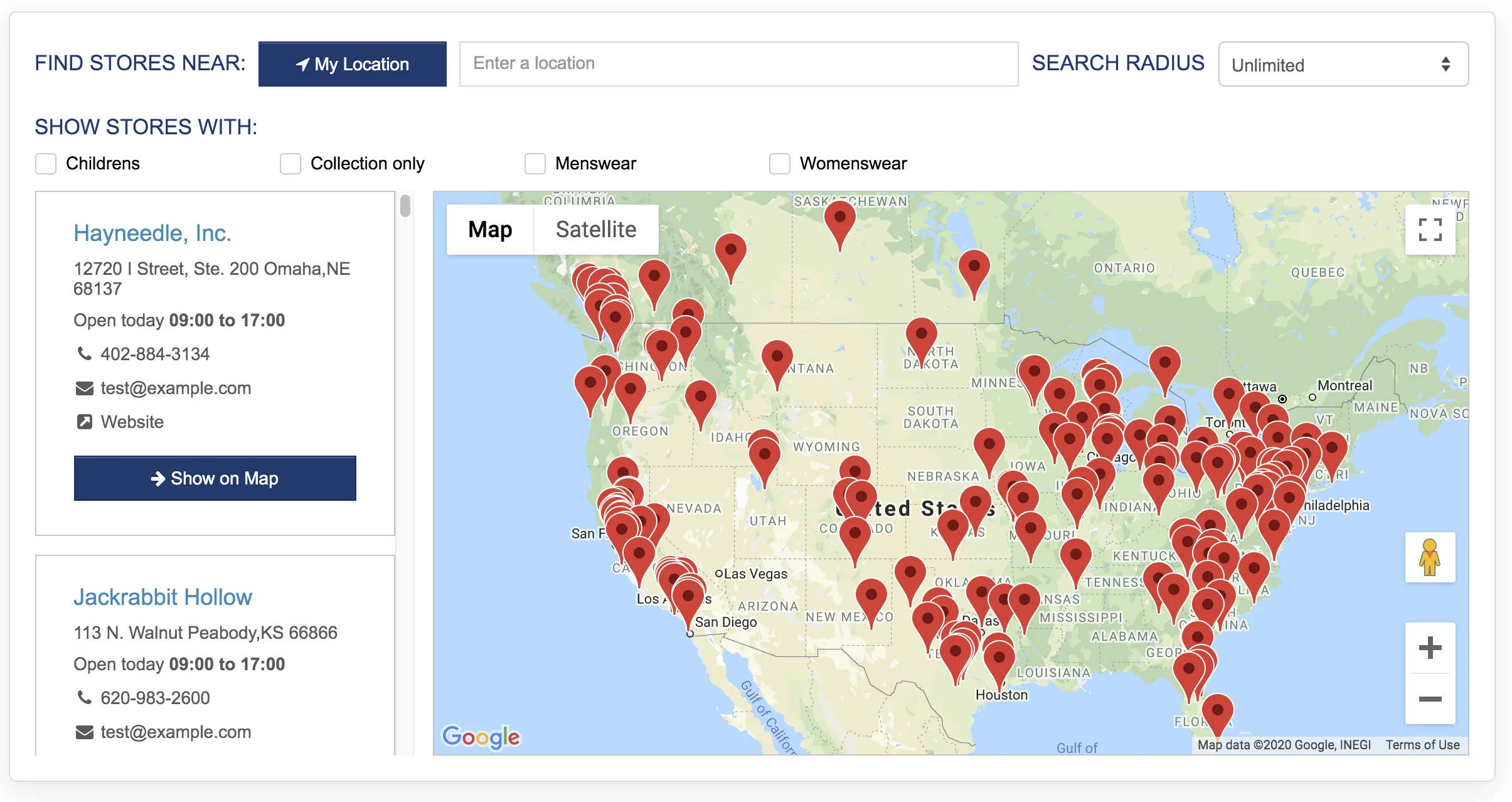
The StoreLocatorWidgets locator, from our review
StoreLocatorWidgets includes map usage in the price. You can use Google Maps, Mapbox or OpenStreetMap without setting up your own Google billing account, so there's no separate bill from a map provider if your locator gets busy.
Plans run from $19 a month for 100 locations to $39 for 1,000, $79 for 10,000 and $299 for 100,000. The $39 Premium plan adds Google Sheets and Airtable sync, multi-language support, white labelling and search analytics. Imports accept CSV and Excel files with column mapping and duplicate detection. There are checkbox, dropdown and hidden filters, location submission forms, ratings and reviews, and APIs for managing and searching locations. It installs as a Shopify app or WordPress plugin and works on Wix, Squarespace, Webflow and any HTML page. In our review it earned our top rating.
Pros
- Map usage included, with no Google billing account to set up
- Sheets sync, multi-language and analytics from $39 for 1,000 locations
- CSV and Excel import with duplicate detection
- Free plan for a single location and a 14-day full-feature trial
Cons
- Click tracking needs the $79 Professional plan
- Multi-language and sync aren't on the $19 entry plan
2. Stockist
Best for: Brands selling through retailers, especially on Shopify, with up to 2,000 stockists.
- Our rating
- Paid plans from
- $10 (100 locations)
- Free plan / trial
- ✕ · 14 days
- Map providers
- Google Maps, Mapbox
Stockist is cheaper than Storemapper at every comparable size: $40 covers 2,000 locations with Google Sheets sync, analytics and 4 languages, against $69.99 at Storemapper. Like Storemapper, it needs your own map key.
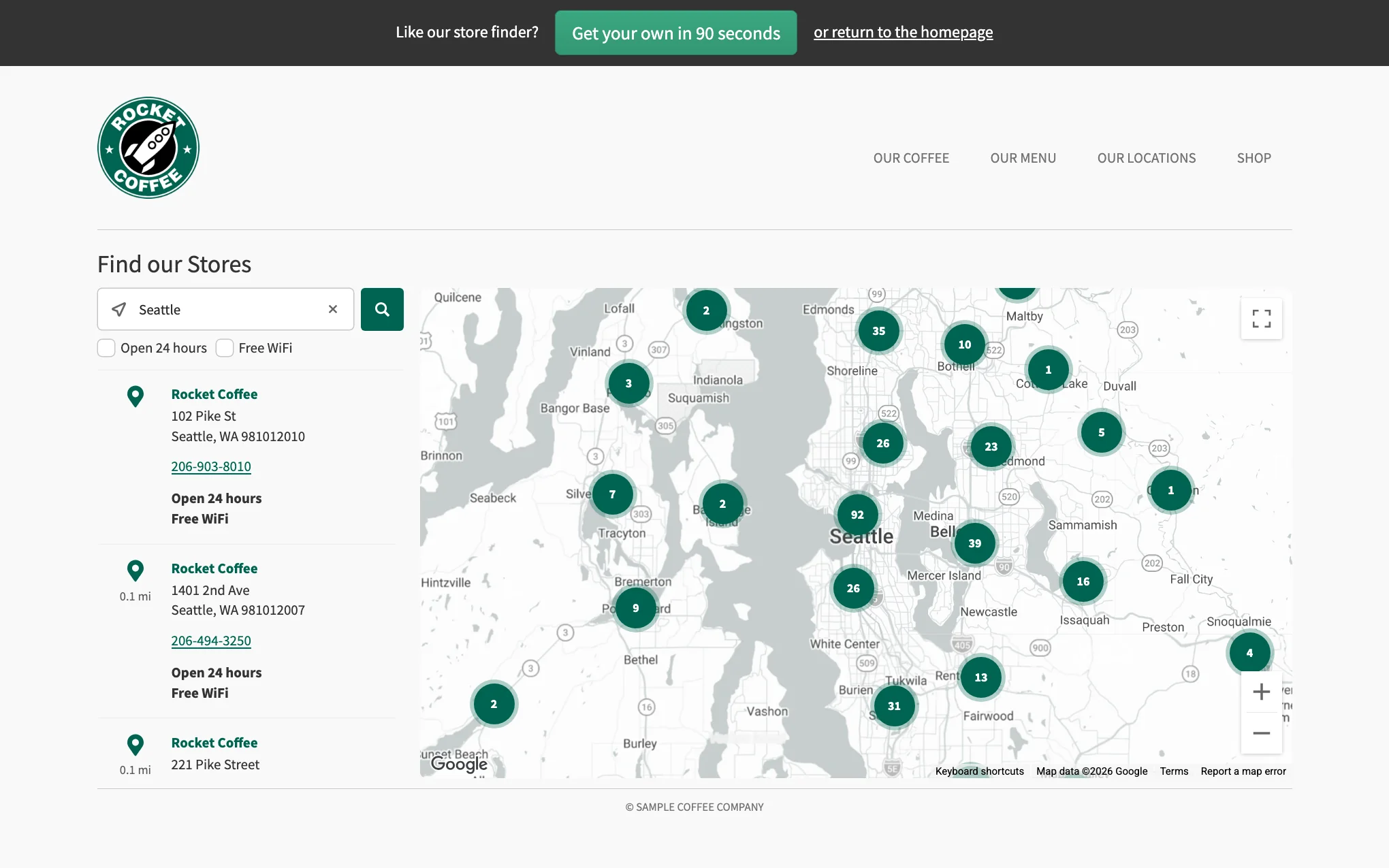
Stockist's demo locator
Stockist is built for brands that want a "where to buy" page listing the shops that carry their products. It has the strongest reputation of any store locator on the Shopify App Store: 5.0 from 353 reviews, with support singled out again and again.
Plans are $10 for 100 locations, $20 for 500 and $40 for 2,000, with 20% off for annual billing. Every plan has spreadsheet import, unlimited filters and custom map pins. Search analytics and map themes start on the $20 Plus plan, and Google Sheets sync and removing the "powered by" link need the $40 Premium plan. You supply your own Google Maps or Mapbox key.
Pros
- Excellent support reputation (5.0 from 353 Shopify reviews)
- Low entry price and simple plans
- Unlimited filters with per-filter map pins
Cons
- Needs your own Google Maps or Mapbox key
- Sheets sync only on the $40 plan, and it runs once a day
- Standard plans stop at 2,000 locations
3. Storepoint
Best for: Webflow sites and teams that want their locator connected to Airtable, HubSpot or Zapier.
- Our rating
- Paid plans from
- $25 (200 locations)
- Free plan / trial
- ✕ · 7 days
- Map providers
- Google Maps, Mapbox
Storepoint's $99 Business plan has unlimited locations, half the price of Storemapper's unlimited Corporate plan, and it offers the APIs and integrations Storemapper doesn't list.
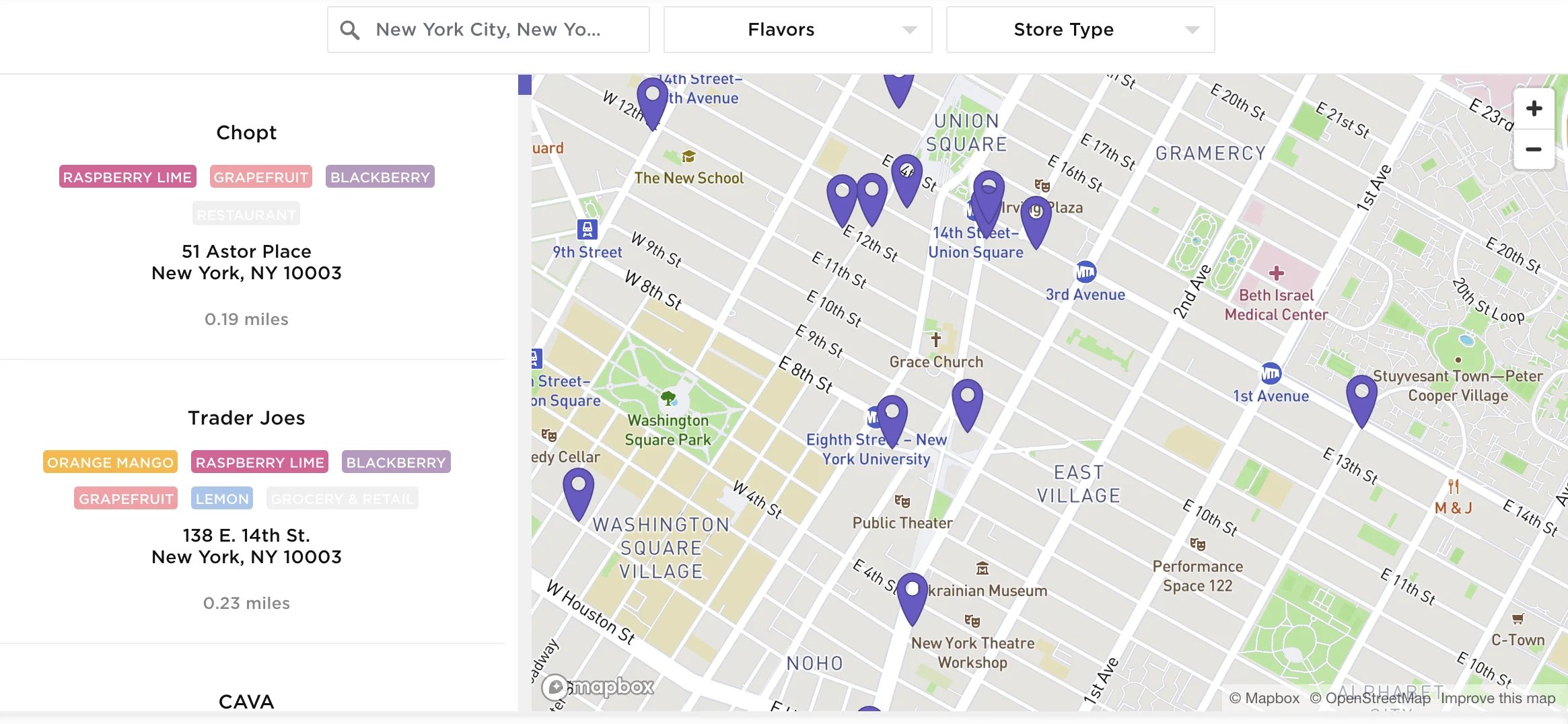
A Storepoint locator, from our review
Storepoint stands out for integrations. It syncs with the Webflow CMS, Airtable, HubSpot and Zapier, and its Google Sheets sync runs daily on the Pro plan and every 5 minutes on Business. It has location management, query and JavaScript APIs.
Plans are $25 for 200 locations, $49 for 2,000 with multi-language support and analytics, and $99 for unlimited locations. You connect your own Google Maps or Mapbox account. In our 2021 review we liked its filter management and found problems with imports and analytics.
Pros
- Unlimited locations for $99
- Webflow CMS, Airtable, HubSpot and Zapier integrations
- Sheets sync every 5 minutes on Business
Cons
- Needs your own Google Maps or Mapbox account
- Multi-language and analytics need the $49 Pro plan
- No free plan
4. StoreRocket
Best for: Businesses that want lead capture when a visitor can't find a nearby location.
- Our rating
- Paid plans from
- $25 (100 locations)
- Free plan / trial
- ✕ · 7 days
- Map providers
- Google Maps, Mapbox
StoreRocket is priced close to Storemapper and gates features in a similar way, so the reason to choose it is lead capture, Excel import or its REST API.
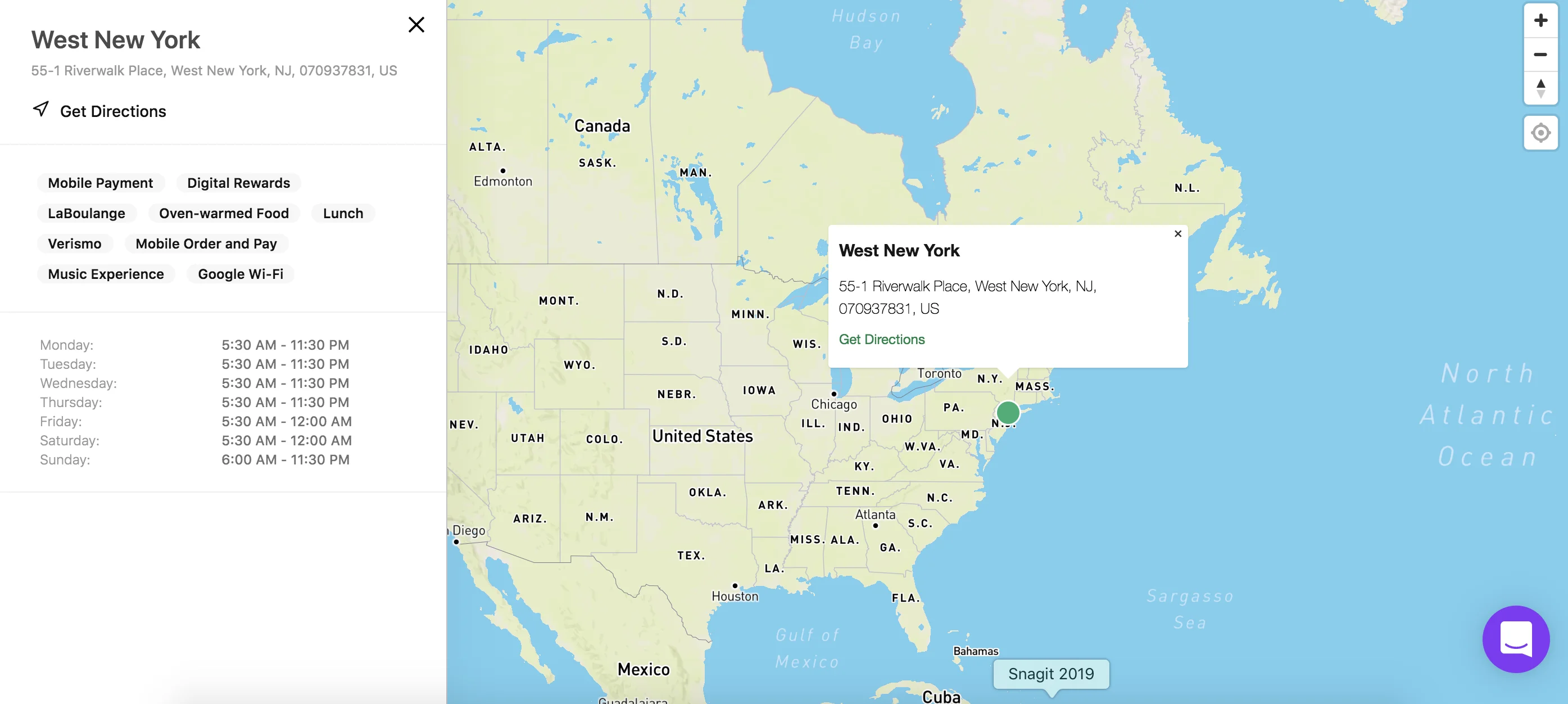
The StoreRocket locator, from our review
StoreRocket has a modern locator and a feature most others lack: if a visitor's search finds no location nearby, it can ask for their details so you can follow up. It imports CSV and Excel files on every plan.
Plans are $25 for 100 locations, $39 for 1,000 with analytics, and $69 for 20,000. Google Sheets sync, multi-language support, the REST API and lead capture are all on the $69 Business plan. You connect your own Google Maps or Mapbox key. Our earlier review found store management awkward with large lists.
Pros
- Lead capture when no nearby location is found
- CSV and Excel import on every plan
- 20,000 locations on the Business plan
Cons
- Sheets sync, multi-language and API only on the $69 plan
- Needs your own Google Maps or Mapbox key
- No free plan
5. MetaLocator
Best for: Larger companies whose location data lives in a CRM or listings platform.
- Our rating
- Paid plans from
- $19 (100 locations)
- Free plan / trial
- ✕ · 30 days
- Map providers
- MapTiler, Mapbox, Google Maps
MetaLocator goes far beyond Storemapper in integrations and lead handling, but its equivalent of Storemapper's Premium features starts at $199 a month.
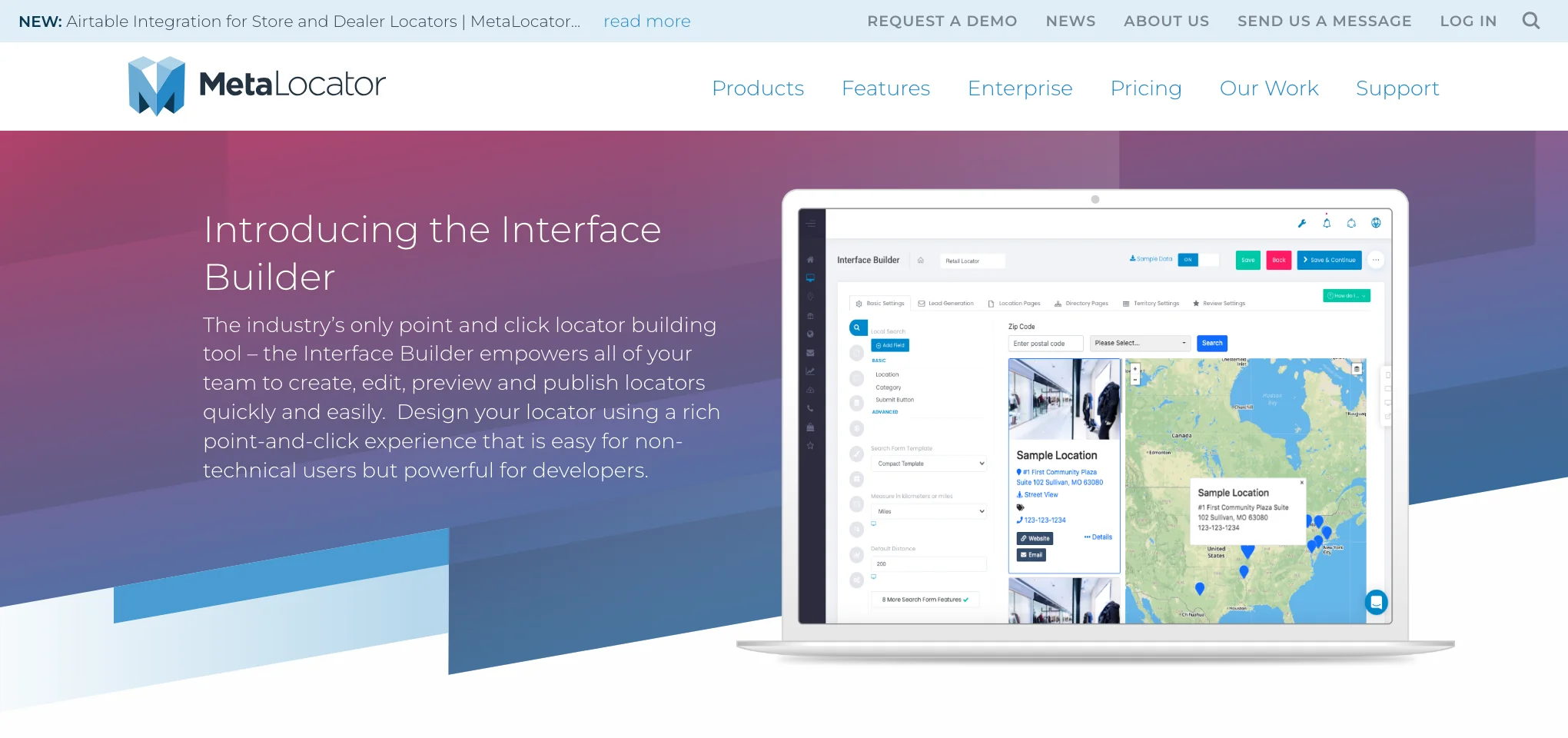
MetaLocator's Interface Builder, as shown on its website
MetaLocator is aimed at larger organisations. It can pull locations from Salesforce, HubSpot, Microsoft Dynamics, Yext and SFTP, route leads to dealers, and offers SSO, a SOC 2 report and SEO location pages. Its Interface Builder gives fine control over layout.
Plans are $19 a month for 100 locations, $49 for 10,000 and $199 for 100,000 ($17, $41 and $167 if billed annually), each with a monthly page-view allowance. Many headline features are on the higher plans: Google Drive, Airtable and Salesforce sync start at $199, and the APIs, most integrations and the included translations are Enterprise only. Maps via MapTiler are included.
Pros
- Deep CRM and data integrations
- Lead capture and routing from the $49 plan
- Maps included via MapTiler, and a 30-day trial
Cons
- Data sync starts at $199; APIs are Enterprise only
- Monthly page-view limits on every paid plan
- More complex than most small businesses need
6. Closeby
Best for: Small businesses that want the lowest cost with no map keys to manage.
- Our rating
- Paid plans from
- $9.99 (100 locations)
- Free plan / trial
- Yes (5 locations) · 14 days
- Map providers
- Closeby maps (OpenStreetMap data); Mapbox with your own token
Closeby covers the same 10,000 locations as Storemapper's $69.99 plan for $19.99, with maps and Google Sheets sync included.
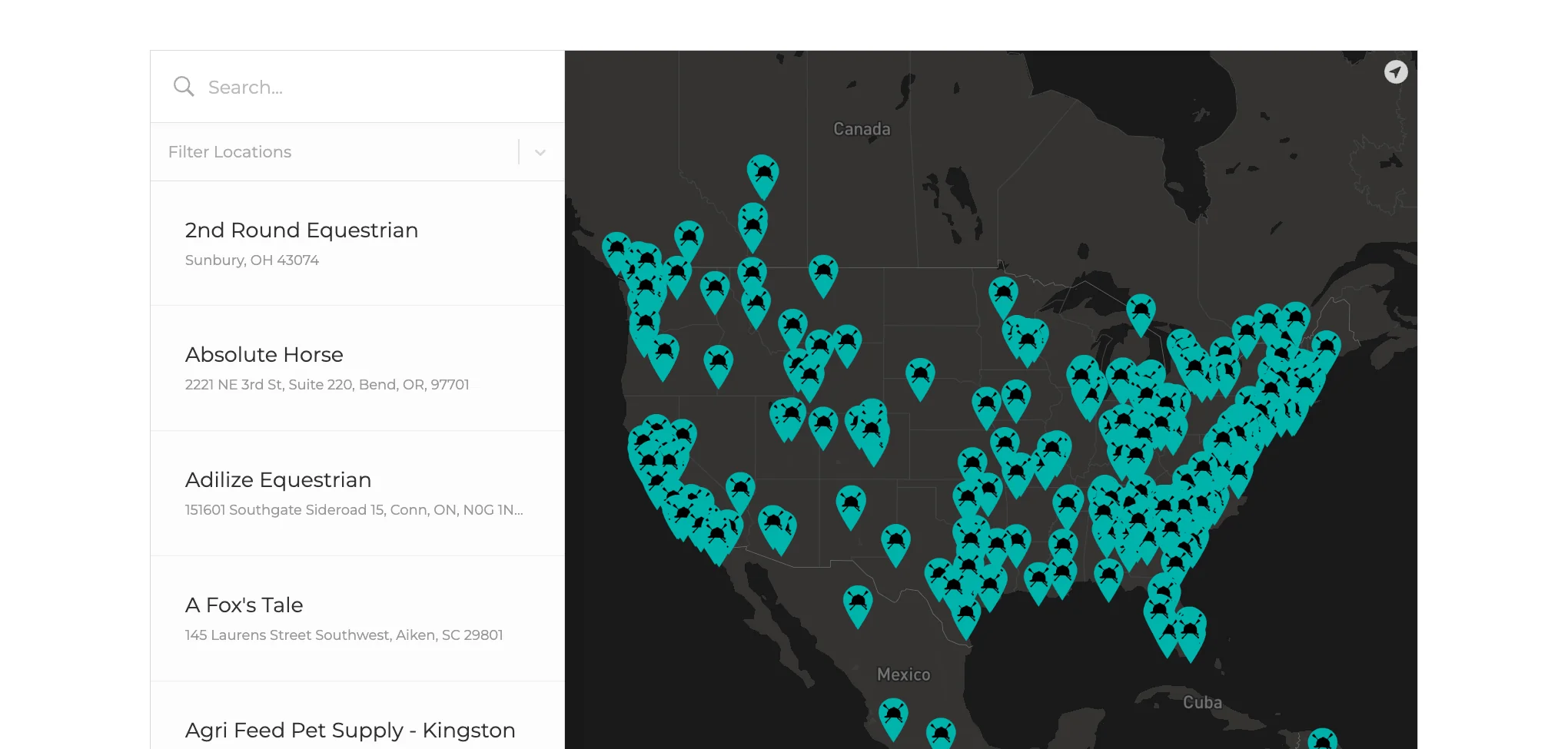
A Closeby locator on a customer's store
Closeby is the cheapest option for larger lists: $9.99 a month for 100 locations and $19.99 for 10,000, with every feature on both, plus a free plan for 5 locations. Its own maps are included with no API key or per-view fee.
It offers 22 themes, category filters, Google Sheets sync (up to 2,500 locations) and Google Analytics events. The trade-offs: imports are CSV only and must match its template exactly, each map has one language, there's no API, and support is email only from a small team.
Pros
- 10,000 locations for $19.99, all features included
- Maps included, no API key needed
- Free plan for up to 5 locations
Cons
- No Google Maps option and no API
- One language per map
- Email-only support from a small team
7. Storeify
Best for: Shopify-only stores on a tight budget.
- Our rating
- Paid plans from
- $8.99 (100 locations)
- Free plan / trial
- Yes (1 location) · 14 days
- Map providers
- Google Maps
Storeify costs well under half of Storemapper at each size and adds store detail pages, but only runs on Shopify.
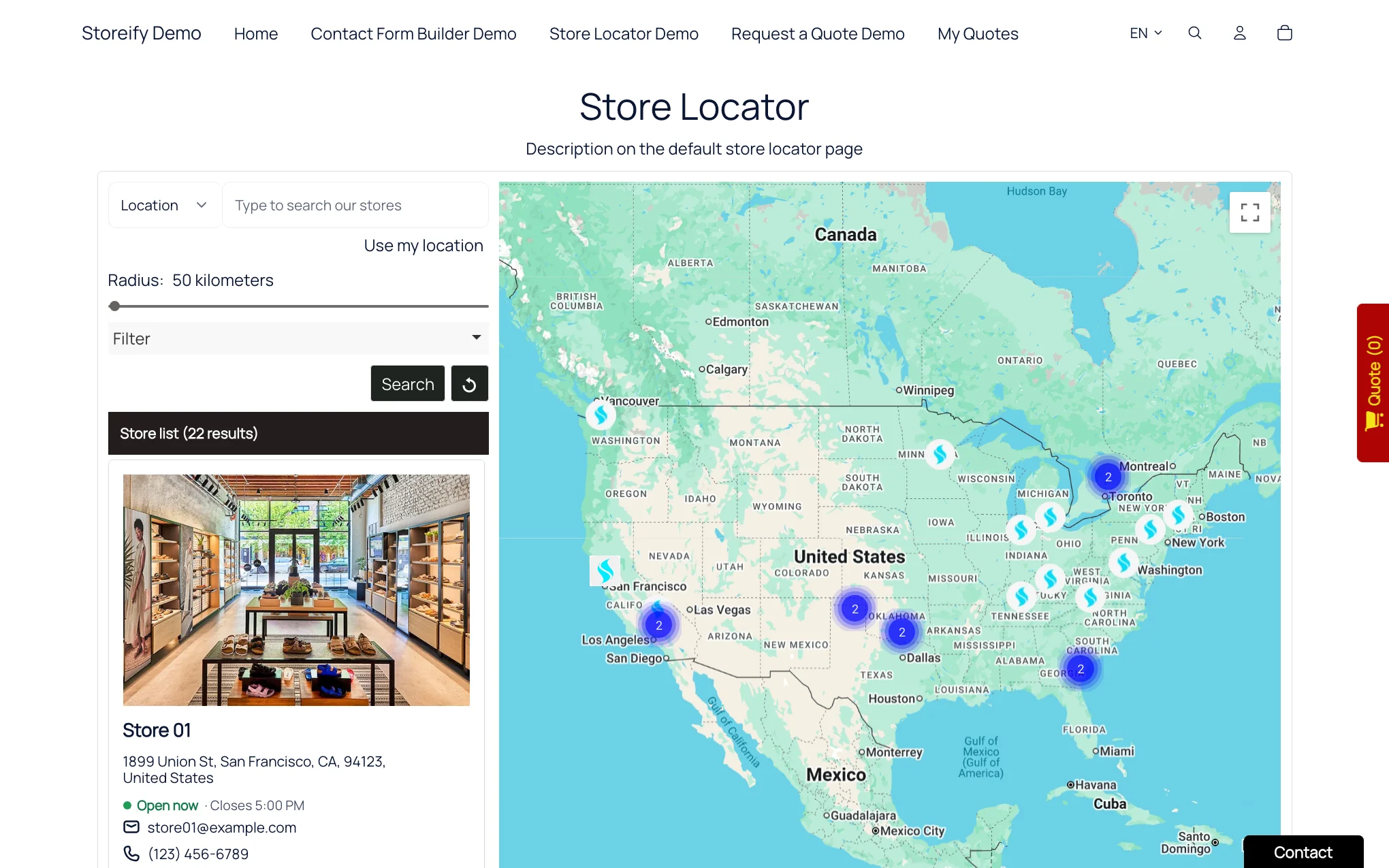
Storeify's default locator on its demo store
Storeify Store Locator is a Shopify-only app rated 4.9 from 207 reviews. It has 8 layouts, store detail pages, a dealer registration form and a free plan for one location.
Paid plans are $8.99 for 100 locations, $19.99 for 1,000 and $39.99 for 5,000. Google Sheets auto-sync starts on the $19.99 plan. It uses Google Maps only, and you need your own Google API key and billing account.
Pros
- Low prices and a free plan
- 8 layouts, store pages and a dealer form
- Strong Shopify rating (4.9 from 207 reviews)
Cons
- Shopify only
- Needs your own Google key and billing account
- No API
ZenLocator has one of the best-designed locators we've reviewed, but its website hasn't been updated since 2021 and its plans start at $49 a month per locator. We'd want to see signs of active development before recommending it as a replacement for Storemapper.
Mapply no longer appears to be operating. Its website now shows a placeholder page, so we've left it out.
- Choose StoreLocatorWidgets if you want Google Maps without a Google billing account, or you need sync, multi-language and analytics for up to 1,000 locations at $39.
- Choose Stockist if you're a brand listing retailers on Shopify and want a simple, well-supported locator from $10.
- Choose Storepoint if your site runs on Webflow or your locations live in Airtable or HubSpot.
- Choose StoreRocket if you want to capture leads from visitors with no nearby location.
- Choose MetaLocator if your location data lives in Salesforce, Yext or another enterprise system and you have the budget for its higher plans.
- Choose Closeby if you want the lowest monthly cost for a large list and are happy without Google Maps.
- Choose Storeify if you're on Shopify only and need something cheap and simple.
If you're happy with Storemapper's features and the price works for you, staying put is a reasonable choice too.
- Export your locations. Every Storemapper plan includes bulk export, so download your full location list as a CSV file.
- Start a trial with your new locator and import the file. Check the column mapping, especially address fields, phone numbers, website links and any tags you use as filters.
- Set up maps. If your new locator needs its own Google Maps or Mapbox key, you can usually reuse the key you set up for Storemapper. If it includes map usage, you can skip this step.
- Recreate your filters and styling, such as product categories, store types, map colours and markers.
- Replace the embed code on your store locator page. Keep the same page URL so you don't lose search rankings or break links.
- Test searches, directions links and filters on desktop and mobile, then cancel your Storemapper plan.
How much does Storemapper cost?
Storemapper's plans are Micro at $24.99 a month (100 locations), Pro at $49.99 (1,000 locations), Premium at $69.99 (10,000 locations) and Corporate at $199.99 (unlimited locations). Annual billing costs $249, $499, $699 and $1,999 a year. There's a 7-day free trial.
Is there a free alternative to Storemapper?
Yes, for small location lists. StoreLocatorWidgets and Storeify have free plans for 1 location, and Closeby's free plan covers up to 5 locations with every feature. For more locations, Closeby and Storeify have paid plans from under $10 a month.
Which Storemapper alternatives don't need a Google Maps API key?
StoreLocatorWidgets and Closeby include map usage in the subscription, so you don't need your own Google or Mapbox key or billing account. MetaLocator includes MapTiler maps. Stockist, Storepoint, StoreRocket and Storeify need your own key, as Storemapper does.
Can I move my locations from Storemapper to another store locator?
Yes. Export your locations from Storemapper as a CSV file, then import that file into your new locator. All the alternatives here accept CSV imports.
Is Storemapper still available?
Yes. Storemapper is still running and offers four plans and a Shopify app, as of November 2026.
We compared each locator on the same criteria we use for our reviews: mapping services, multi-language support, filtering, analytics, data import, customization, support and pricing. Prices and plan details come from each vendor's pricing page and Shopify App Store listing, and were last checked on 12 November 2026. Star ratings come from our full reviews.